
The Advantage Hierarchy Collapsed
For fifty years, the hierarchy of competitive advantage was stable. Capital at the top — the company with more money could outspend, out-hire, and out-market everyone else. Below that, talent — the company with better people built better products. Below that, product quality — the company with the superior offering won the market.
AI demolished that hierarchy in about 18 months.
Capital advantage? A solo founder with CEO.ai can now produce the same volume of content, proposals, research, and operational output as a 30-person team. The capital moat is shallow when a $200/month platform replaces $40K/month in labor.
Talent advantage? The best prompt engineer in the world is still limited by the same 24 hours as the worst one. AI agents don't sleep, don't call in sick, and don't need 6 months of onboarding to learn your business. Talent still matters — but its leverage has shifted from execution to direction.
Product quality? When anyone can build a custom tool in an afternoon using plain English, the window between "innovative product" and "commodity" collapsed from years to weeks.
What's left? Speed. The company that goes from idea to implementation in hours while competitors take weeks. The company that launches, learns, iterates, and relaunches before the competition finishes their first planning meeting. Speed of execution is no longer one advantage among many. It's the advantage that compounds all the others.
The Anatomy of Slowness
Before we talk about speed, we need to understand what makes businesses slow. It's not laziness. It's not lack of ambition. Slowness is structural. It's built into the way companies operate, and it comes from four specific bottlenecks.
Sequential execution
Most businesses operate in chains. Research finishes, then writing starts. Writing finishes, then design starts. Design finishes, then review starts. Each link in the chain waits for the previous one. A 5-step process that takes 2 hours per step doesn't take 10 hours — it takes 3-5 days once you add scheduling gaps, handoff delays, and the inevitable "I'll get to it after my 2pm meeting" lag between steps.
The CEO bottleneck
At companies with 5-50 people, the CEO is the approval checkpoint for anything important. Every decision waits in their queue. Their context window is maxed. Their calendar is packed. A task that takes 10 minutes to complete waits 48 hours for the CEO to look at it. The work isn't slow. Access to the decision-maker is slow.
Context re-creation
Every time a task passes from one person (or tool) to another, context gets lost and must be re-created. The research you did yesterday? The writer needs a 15-minute briefing to understand it. The writer's draft? The reviewer needs 10 minutes to absorb the brief before they can evaluate the writing. Multiply this across every handoff in every workflow. The cumulative cost of re-creating context is staggering — and invisible on any time sheet.
Tool fragmentation
You research in one tool. Write in another. Design in a third. Publish in a fourth. Track results in a fifth. Each tool switch costs context, costs time, and introduces the risk of something falling through the crack between platforms. The tools themselves might be fast. The gaps between them are where velocity goes to die.
None of these bottlenecks are about effort. Your team works hard. The problem is structural. Sequential processes, centralized approvals, lost context, and tool fragmentation create a system where the actual work takes 10% of the elapsed time and the other 90% is waiting, re-explaining, switching, and queuing.
Parallel Beats Sequential
The single biggest speed unlock AI agents offer isn't that they work faster than humans on individual tasks. Some do, some don't. The unlock is that agents can work in parallel.
A human team operates sequentially by nature. Sarah finishes the research, hands it to Mike for writing, Mike finishes the draft, hands it to Lisa for review. Three people, three steps, three handoffs. Even if each step takes only an hour, the process takes a minimum of 3 hours — and in practice, with scheduling and context transfer, more like 2-3 days.
An AI agent system can run the research, begin drafting based on partial research results, and have the review agent pre-loaded with your quality standards — all simultaneously. Not by cutting corners. By eliminating the idle time between steps, eliminating context re-creation (agents share memory), and eliminating scheduling gaps (agents don't have calendars).
The difference between sequential and parallel execution isn't linear — it's exponential as complexity grows. A 3-step process is 3× faster in parallel. A 10-step process with interdependencies? It can be 15-20× faster, because parallel agents eliminate not just wait times but the cascading delays that multiply through long chains.
Practical example. A CEO on the platform described wanting to launch a new service offering. In a traditional process, this would look like:
- Week 1: Research the market, talk to 5 potential clients
- Week 2: Write the service description, define pricing
- Week 3: Build a landing page, create sales materials
- Week 4: Launch, start outreach
With coordinated AI agents: research agent gathers market data and competitor pricing while the writing agent drafts the service description based on existing offerings. Website Creator builds the landing page in parallel. Sales materials get drafted as the pricing crystallizes. Total elapsed time: one weekend. The CEO spent Saturday morning giving direction and Saturday afternoon reviewing outputs.
Same quality. Same thoroughness. Four weeks compressed to two days. Not by rushing. By removing the dead space between steps.
Orchestration, Not Tools
Here's where most people go wrong. They hear "speed" and they buy faster tools. A faster writing tool. A faster design tool. A faster research tool. Each tool is individually quick. The total system is still slow because the tools don't talk to each other.
Speed doesn't come from faster point tools. It comes from orchestration — the coordination layer that routes work between agents, shares context automatically, handles handoffs without human intervention, and keeps multiple workstreams moving simultaneously.
"I had 6 AI tools. Each one was fast. But I was the integration layer. I was copying outputs from one tool, reformatting them, and pasting them into the next tool. The tools were fast. I was the bottleneck. The system was slow because the system was me."
— CEO of a 19-person e-commerce brand
This is the critical distinction between a collection of AI tools and an AI agent system. Tools do tasks. Systems do workflows. The speed advantage lives in the workflow — in the coordination, the handoffs, the parallelism, and the shared context that eliminates re-explanation at every step.
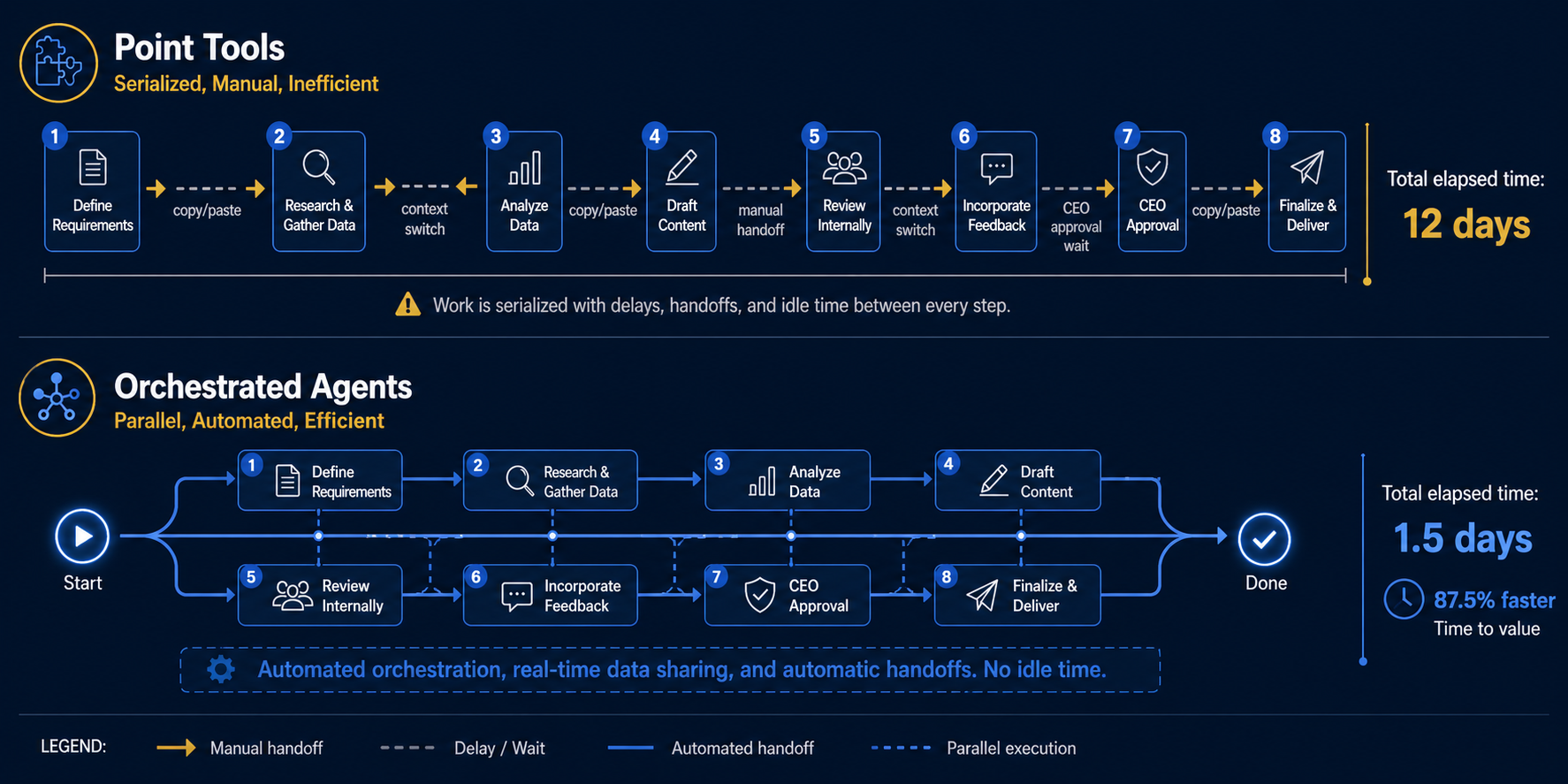
CEO.ai was built as an orchestration layer first, task tools second. The Agent Manager doesn't just let you create agents — it lets you wire them together into workflows where output flows automatically, context is shared through long-term memory, and parallel execution is the default, not the exception.
Speed Without Recklessness
The obvious objection: doesn't going faster mean making more mistakes? Doesn't speed sacrifice quality?
No. That conflation is the legacy of a world where speed required cutting corners. When humans rush, quality drops. When AI agents run in parallel, quality doesn't change — because each agent is executing at its full capability regardless of how many other agents are running simultaneously.
The quality bottleneck was never speed. It was context loss. Errors happen when information gets dropped between steps. When the writer doesn't get the full research. When the reviewer doesn't know the client's preferences. When the final version gets published without the CEO's last edit.
Orchestrated agents eliminate context loss by sharing memory. Every agent in a workflow has access to the same knowledge base, the same correction history, the same business context. The research agent's findings are instantly available to the writing agent — not through a briefing document, but through shared memory. Nothing gets dropped because nothing gets transferred. It's already there.
- Speed + shared memory = fewer errors, not more. Context loss is the #1 source of mistakes. Eliminate context loss and quality goes up even as velocity increases.
- Speed + iteration = better outcomes. When you can ship v1 in a day instead of a month, you get market feedback 30× sooner. Feedback loops compress. Learning accelerates. v3 of your fast-shipped product beats v1 of your competitor's slow-shipped product — because you've already learned from two rounds of real-world data.
- Speed + transparency = confidence. When every agent's work is auditable and traceable, you can move fast and verify fast. You don't slow down to build trust — you verify in real time as the work flows.
Speed isn't recklessness. Speed is the removal of waste. The waiting. The re-explaining. The tool-switching. The scheduling. The queue. Remove the waste and what's left is pure execution — and it's fast because there's nothing slowing it down anymore.
Speed advantages compound. The company that ships 4× faster doesn't just deliver 4× more — they learn 4× faster, iterate 4× more, and build compound intelligence 4× sooner. After 6 months, the gap isn't 4×. It's closer to 20× — because every cycle builds on the previous one.
Your competitors are adopting AI too. The ones using point tools — a writing tool here, a research tool there — are getting incrementally faster on individual tasks. The ones building orchestrated agent systems are getting structurally faster on entire workflows. That structural speed is the competitive advantage that's hardest to copy and most dangerous to face.
The question isn't whether you can afford to go faster. The question is whether you can afford to let your competitors go faster than you.
Key Takeaways
- → The old advantage hierarchy collapsed. Capital, talent, and product quality all matter less when AI agents level the playing field. Speed of execution is the primary remaining competitive advantage.
- → Businesses are slow for structural reasons — sequential execution, CEO bottlenecks, context loss at every handoff, and fragmented tools. The work is fast. The system around the work is slow.
- → Parallel agent execution is the unlock. AI agents eliminate idle time, shared memory eliminates context re-creation, and automatic handoffs eliminate scheduling gaps. A 4-week process becomes a weekend.
- → Speed comes from orchestration, not faster point tools. Six fast tools with a human integration layer are still slow. One coordinated agent system where work flows automatically is structurally faster.
- → Speed advantages compound. Faster shipping means faster learning, faster iteration, and faster intelligence accumulation. After 6 months, the gap between you and a slower competitor isn't arithmetic — it's exponential.
Go From Idea to Implementation Today
Describe what you want to build, launch, or automate. CEO.ai's coordinated agent system turns your description into working output — not next quarter, but now.

Greg Marlin
Founder, CEO.ai
Greg watched companies with worse products win markets because they shipped faster. He built CEO.ai as an execution engine — not just AI that does individual tasks, but a coordinated system that collapses the timeline between idea and implementation. He writes about speed as the strategy that makes all other strategies possible.