
The Amnesia Problem
Imagine hiring someone brilliant. Sharp, fast, capable of anything you throw at them. One problem: they wake up every morning with total amnesia. No memory of yesterday's work. No memory of your preferences. No memory of the mistake you corrected, the client they researched, or the writing style you spent 20 minutes explaining.
Every single day, you start from scratch. Re-explain the business. Re-state your preferences. Re-provide the context. Re-correct the same error.
That's what using most AI tools feels like. ChatGPT doesn't remember last Tuesday. Your Jasper workspace doesn't know that you corrected the tone three times last month. Your Zapier workflow can't learn that the Thursday report always needs a different format than the Monday one. Every interaction is session zero.
Now multiply that by 5 or 10 AI tools across your business. Each one stateless. Each one brilliant in the moment and completely blank the next. You're not building on anything. You're rebuilding constantly.
This is the amnesia problem. And it's the reason most businesses that adopt AI see a spike of productivity in week one and a plateau by week four. The tools don't get better. You just get better at prompting them — which means the productivity gain came from you, not from the AI.
What Compound Intelligence Looks Like
Compound interest is the most powerful force in finance. You put in a dollar, it earns a return, the return earns its own return, and the curve goes exponential. Everyone understands this with money.
Compound intelligence is the same principle applied to knowledge. Your AI system handles a task. It learns something from that task — your preference, a correction, a pattern, a business rule. Next time, it starts from that new baseline instead of from zero. The interaction after that builds on the one before. Week over week, the system gets measurably better at operating your specific business.
Week 1: the AI writes a client proposal. It's generic. You mark it up heavily.
Week 4: the AI writes a proposal that nails your tone, includes the right case studies, and formats the pricing section the way your clients expect. You change two sentences.
Week 12: the AI drafts the proposal, attaches the right case studies based on the prospect's industry, adjusts pricing to match the tier you've quoted for similar deals, and sends it to the prospect for your approval. You click "send."
Week 24: you didn't even know the proposal went out. The AI identified the opportunity from a conversation log, built the proposal from accumulated knowledge, sent it through your approval workflow, and followed up. You found out when the prospect replied.
The difference between AI-as-a-tool and AI-as-a-teammate isn't intelligence — it's accumulation. A tool helps you do the work. A teammate that compounds means less work to do, period, because the system absorbs more of the job over time.
The Five Layers That Compound
Compound intelligence isn't one thing. It's five distinct types of knowledge accumulating in parallel, each reinforcing the others. Most AI tools have zero of these layers. That's not a feature gap — it's an architecture gap.
Preference Memory
How you like things done. Your tone of voice. The format you want reports in. Whether you say "Hi" or "Hey" in client emails. The fact that you hate bullet points in proposals but love them in internal docs. These aren't instructions you should have to repeat. They're preferences your system should learn once and apply forever.
Business Knowledge
Your products, your pricing tiers, your service agreements, your competitive positioning, the questions prospects always ask, the objections that always come up at the same stage in the sales cycle. This is your institutional knowledge — the stuff that lives in your head and in scattered Google Docs and nowhere else. When AI absorbs it, every output improves because the context is already there.
Correction History
Every edit you make is training data. When you change "synergize" to "work together," that's a signal. When you delete a paragraph, that's a signal. When you rewrite a subject line, the old and new versions together encode your standards better than any style guide could. A compounding system captures these corrections and applies them forward — so you correct once, not fifty times.
Pattern Recognition
After handling 200 client inquiries, a compounding system knows that questions about pricing in the first email correlate with lower close rates — unless the prospect came from a referral. After generating 50 weekly reports, it knows which metrics you actually look at and which you skip. These patterns aren't programmed. They're discovered. And they make every subsequent action more precise.
Workflow Optimization
The sequence of steps itself gets better. First draft of a workflow: research → write → publish. After 30 runs, the system learns that adding a competitive scan between research and writing produces content that performs 40% better. It suggests the change. You approve it once. Now every future run includes it. The workflow evolves.
Stack all five layers and the effect is exponential. Your AI doesn't just remember — it compounds. Month-over-month, the number of things that require your direct input shrinks. The quality of autonomous output climbs. And the gap between what your AI can handle and what you need to handle yourself gets wider in your favor.
Why Most AI Can't Do This
This isn't a feature request most AI companies are ignoring. It's an architecture problem they can't solve with their current approach.
Most AI tools are thin wrappers around a foundation model. You type something in, the model processes it, you get output. The "memory" is the conversation thread, which evaporates when you close the tab. Some tools offer "custom instructions" — a static block of text that gets prepended to every prompt. That's better than nothing, but it doesn't learn, doesn't adapt, and can't hold more than a few hundred words of context.
Compound intelligence requires three things at the infrastructure level that most AI tools simply don't have:
- A persistent knowledge layer that exists outside the model's context window. Not a conversation history. An actual knowledge base that grows, indexes, and retrieves relevant information per-interaction — what's called RAG (Retrieval-Augmented Generation) done right.
- A feedback loop that writes back. When you correct an output, that correction needs to get encoded into the knowledge layer so it affects future outputs. Most tools are read-only — they consume your prompt but don't learn from the result.
- Multi-agent memory sharing. If your writing agent learns that you prefer short sentences in client emails, your sales agent should know that too. Siloed memory means siloed intelligence. Compound intelligence requires agents that share a knowledge graph.
CEO.ai was architected around these three pillars from day one. Not bolted on as an afterthought. The long-term memory system isn't a feature — it's the foundation. Everything else — the agents, the workflows, the coordination layer — sits on top of a knowledge base that grows every time you interact with the platform.
"I realized the shift when my content agent started referencing a client conversation from three months ago that I'd forgotten about. It didn't just remember — it connected that conversation to the current project in a way that was genuinely useful. That's when it stopped feeling like a tool."
— CEO of a 17-person consultancy, 6 months on CEO.ai
The Switching Cost You Actually Want
Normally, switching costs are something companies impose on you against your interest. You stay because leaving is painful, not because staying is better.
Compound intelligence flips that. The switching cost is the accumulated intelligence itself — and it's working for you, not against you. Six months of compound intelligence means your AI knows your 30 biggest clients by name and context. It knows your pricing exceptions. It knows the three things that always go wrong in onboarding and proactively prevents them. It knows your voice so well that clients can't tell the difference between your writing and the AI's.
Walk away from that and start with a new tool? You're back to session zero. You're re-explaining your business, re-correcting the same mistakes, re-training preferences from scratch. That's not vendor lock-in. That's knowledge loss. And it's the same reason you don't fire a great employee who's been with you for three years — not because you can't, but because what they know about your business is genuinely irreplaceable.
Week 1-2: AI handles tasks, but you're correcting constantly. Week 4-8: corrections drop 60-70%. The AI anticipates your preferences. Week 12+: the AI is proactively identifying work, referencing historical context, and producing outputs that need minor tweaks at most. Week 24+: you're managing by exception. The system runs and you steer.
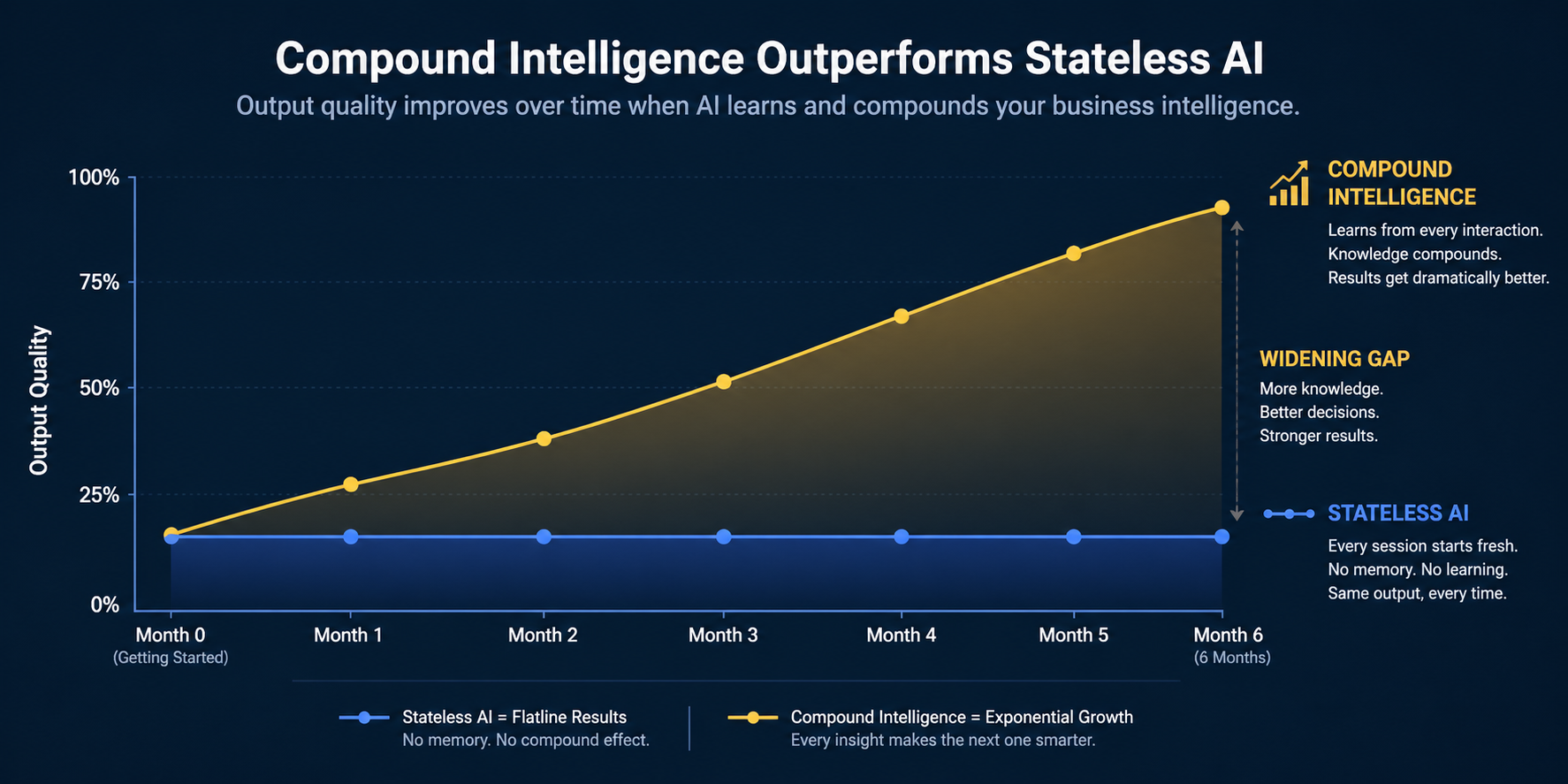
The question isn't whether your AI is smart. GPT-4, Claude, Gemini — they're all smart. The question is whether your AI is getting smarter about your business specifically. If the answer is no, you're renting intelligence. If the answer is yes, you're building it.
That's the bet behind building an AI agent roster on CEO.ai. Every interaction makes it better. Every correction makes it sharper. Every week that passes widens the gap between what a generic AI tool could do and what your system — trained on your business, remembering your patterns, anticipating your needs — actually delivers.
Compound interest made people rich over decades. Compound intelligence can transform your business in months. But only if you start accumulating now. Every day you spend in a stateless tool is a day of knowledge that evaporates instead of compounding.
Key Takeaways
- → Most AI tools are stateless. Every session starts from zero. That's like hiring someone with amnesia every morning — brilliant but useless for building on prior work.
- → Compound intelligence means five layers of knowledge accumulating in parallel: preferences, business knowledge, correction history, pattern recognition, and workflow optimization. Stack them and the curve goes exponential.
- → This requires architecture, not features. You need persistent memory, write-back feedback loops, and shared knowledge across agents. Most AI tools don't have any of the three.
- → The switching cost works in your favor. Six months of accumulated intelligence about your business is genuinely irreplaceable — and it's making your AI better every week, not locking you into a bad deal.
- → Every day in a stateless tool is wasted knowledge. Start compounding now. The gap between where you are and where you could be widens every week you wait.
Start Building Intelligence That Compounds
Tell CEO.ai about your business and start accumulating compound intelligence today. Every interaction makes it smarter about how you work.

Greg Marlin
Founder, CEO.ai
Greg built CEO.ai around a simple observation: the most valuable thing about a great employee isn't their talent on day one — it's everything they learn about your business over months and years. He's obsessed with building AI systems that accumulate the same kind of compounding institutional knowledge.