
The Old Consensus
For the last two decades, every advisor, every mentor, every business podcast gave the same advice to non-technical CEOs: don't build, buy.
Need a CRM? Buy Salesforce. Need email marketing? Buy Mailchimp. Need project management? Buy Monday.com. Need invoicing? Buy FreshBooks. The reasoning was sound: building software was slow (6-12 months minimum), expensive ($50K-$500K for anything decent), and risky (most custom projects failed or went over budget). Buying was instant, predictable, and someone else handled maintenance.
The "buy" advice worked because the alternative — hiring developers, writing specs, managing sprints, debugging releases — was genuinely impractical for a 15-person company. You didn't have the budget. You didn't have the technical knowledge to manage the process. And the opportunity cost of the CEO spending six months on a software project instead of running the business was absurd.
So everyone bought. And everyone compromised.
Your CRM has 400 features and you use 11. Your project management tool forces a workflow that doesn't match how your team actually works. Your invoicing system can't handle your pricing model without ugly workarounds. You're paying $2,800/month across 9 SaaS subscriptions and none of them talk to each other without a Zapier integration that breaks every third Thursday.
The "buy" era wasn't empowering. It was settling.
What Changed
Two things happened simultaneously, and their combined effect is one of those rare, genuine inversions in business strategy.
First: AI collapsed the cost and timeline of building software to near zero. What took a development team 3 months and $80K can now be described in plain English and built in hours. Not a prototype. Not a mockup. Functional software — apps, workflows, agent systems, entire internal tools — deployed and running.
Second: the person doing the building no longer needs to be a developer. The CEO who understands the business problem better than anyone can now describe the solution directly, without translating their knowledge through a developer who's guessing at what they mean. The domain expert is the builder.
The old equation: Building = expensive + slow + risky. Buying = cheap + fast + safe. The new equation: Building = cheap + fast + custom-fit. Buying = expensive + generic + locked-in. The math flipped. The advice should flip with it.
This isn't theoretical. It's happening right now. CEOs who've never written a line of code are building client onboarding systems, internal dashboards, automated reporting pipelines, and AI agent teams that handle entire business functions. They're doing it in afternoons, not quarters. And the results are better than what they could buy — because the builder is the person who actually understands the problem.
The Real Cost of Buying
The sticker price of SaaS is a lie. The $49/month plan isn't $49/month. The real cost of buying off-the-shelf software is the sum of everything you lose by fitting your business into someone else's assumptions.
Let's count the actual costs:
The workflow tax
Every generic tool imposes a workflow. Sometimes it matches yours. Usually it doesn't. You end up reshaping how you work to fit the software instead of the reverse. Your team spends 20 minutes per day on workarounds. Across 15 people, that's 5 hours of wasted productivity. Daily.
The integration tax
Your CRM doesn't talk to your project manager. Your project manager doesn't talk to your invoicing. So you buy Zapier. Or you hire a freelancer to build integrations. Or — most commonly — someone on your team manually copies data from one system to another. The subscription fee was $49. The integration cost is $500/month in hidden labor.
The feature bloat tax
You're paying for 400 features. You use 11. But you can't opt out of the complexity. Your team has to navigate around the 389 features they don't use to get to the ones they do. Training new hires takes longer. The interface is cluttered. The learning curve is steep for a tool that does something conceptually simple.
The lock-in tax
Three years of data in a system that charges you $200/month to export it as a CSV. Your team has built muscle memory around a tool's quirks. Switching feels impossible even when the tool is clearly wrong for you. This isn't a feature — it's a trap.
The "good enough" tax
The most expensive cost of all, and the hardest to quantify. You stop imagining better solutions because you've internalized the limitations of your tools. You don't think "what if my onboarding process could be completely automated?" because your current tool can't do that. Buying off-the-shelf constrains your imagination to the vendor's roadmap.
Add it up and the $49/month tool costs you $1,500-$3,000/month in real terms — per tool — when you account for workarounds, integrations, lost productivity, and settling for workflows that don't match your business.
"I was paying $4,200/month across 11 SaaS tools. I replaced 7 of them with custom-built apps and agent workflows on CEO.ai. Total time to build: about 3 days across two weeks. Monthly cost now: the CEO.ai subscription. But the real savings aren't the dollars — it's that everything finally works the way my business actually operates."
— Owner of a 28-person digital agency
Building for Operators, Not Developers
The inversion only works if the building tool is designed for the person who understands the business. That's the critical caveat everyone glosses over.
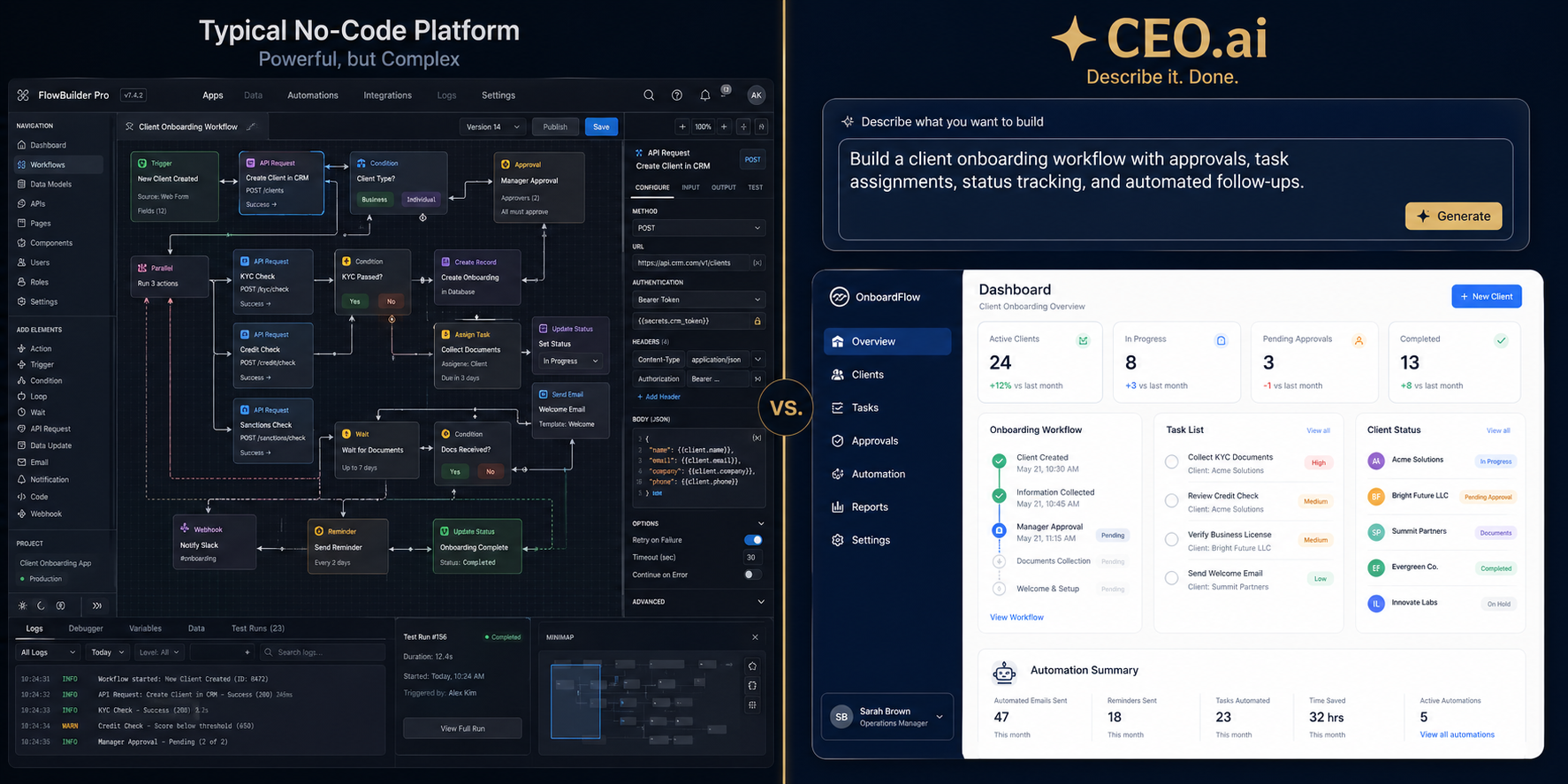
Most "no-code" platforms still think like developer tools. They give you visual programming interfaces, drag-and-drop logic builders, API configuration panels. These are developer concepts with a slightly friendlier wrapper. A CEO who's never thought in terms of "if/then logic trees" or "webhook triggers" hits a wall in 10 minutes.
Building for operators means accepting plain English as the input. Not "create a webhook that triggers when field X changes and posts a JSON payload to endpoint Y." Instead: "When a new client signs up, send them the welcome email, schedule their onboarding call, and create their project workspace."
The gap between those two instructions is enormous. Same outcome. Completely different interface. One requires you to think like a programmer. The other requires you to think like a CEO — which you already do.
Can you describe what you want built in the same language you'd use to explain it to a sharp new employee? If yes, and the platform builds it — that's operator-grade building. If you have to learn the platform's language first, it's still a developer tool wearing a costume.
This is the design philosophy behind CEO.ai's App Creator and the Agent Creator. You describe what you need. The system builds it. Not a wireframe. Not a mockup. A working application or agent team, deployed, with the logic, the data connections, and the workflow already configured.
You iterate by talking, not by coding. "Make the dashboard show last 90 days by default instead of 30." "Add a step where the agent checks inventory before confirming the order." "Change the email tone to be more formal for enterprise clients." These are corrections anyone can make — because they're expressed in the same language you think in.
What CEOs Are Building Right Now
The shift isn't hypothetical. CEOs on CEO.ai are already building tools that replace multiple SaaS subscriptions and outperform them — because the tools are custom-fit to their exact business logic. Some examples:
- A client intake and quoting system that replaced a combination of Typeform + Google Sheets + manual email. One description, one build. Prospects fill out a form, an agent pulls relevant pricing, generates a custom quote, and sends it — with the CEO's approval for deals over $10K. Time to build: 2 hours. SaaS it replaced: $340/month.
- A weekly performance dashboard that pulls data from Stripe, Google Analytics, and their project management tool, then generates a written executive summary with insights and recommendations. Runs every Monday at 6am. Replaced: a $180/month analytics tool + 3 hours of manual reporting per week.
- An AI agent team for content production — research agent, writing agent, editing agent, publishing agent — that produces 3 blog posts per week in the company's voice, with SEO optimization and internal linking. Built over a weekend. Replaced: a $3,500/month content agency that needed weekly calls to stay on brief.
- A customer support triage system that reads incoming tickets, categorizes them by urgency and topic, drafts responses for routine questions using the company's knowledge base, and escalates genuine problems to the right person. Replaced: a $250/month helpdesk tool + 1.5 hours/day of manual triage.
None of these CEOs are technical. None of them wrote code. They described what they wanted — the same way they'd describe it to a new operations hire — and the platform built it. Then they iterated in conversation until it worked exactly the way their business needed.
The build vs. buy inversion isn't about technology changing. It's about who gets to build changing. For 20 years, building was reserved for people who could code or afford to hire people who could. That gate is gone. The CEO who understands the problem better than anyone can now build the solution directly, in their own language, in their own time.
If you're still buying generic tools and bending your business to fit them, you're operating under the old rules. The new rules say: describe it, build it, own it. That's not a slogan. It's a capability that exists today.
Key Takeaways
- → The 20-year "don't build, buy" consensus is inverted. AI collapsed the cost and timeline of building custom software from months/$100K+ to hours/$0 in developer payroll.
- → The real cost of buying isn't the subscription. It's the workflow tax, integration tax, feature bloat tax, lock-in tax, and the invisible "good enough" tax that constrains your imagination to the vendor's roadmap.
- → The inversion only works if the building tool is designed for operators. If you have to think like a programmer, it's still a developer tool. Plain English in, working software out — that's the bar.
- → CEOs are already building custom tools that outperform SaaS. Client intake systems, dashboards, content pipelines, support triage — all built by non-technical founders in hours, not months.
- → The person who understands the problem best should build the solution. That's you. AI removed the barrier that prevented it. The only question is whether you keep renting generic tools or start building exactly what your business needs.
Build the Tool You've Always Wanted
Describe the app, workflow, or agent team your business actually needs. No code. No developer. Just plain English and the tool comes to life.

Greg Marlin
Founder, CEO.ai
Greg spent years buying software that almost fit his businesses and wishing he could build exactly what he needed. CEO.ai is the result — a platform where operators describe what they want and get working tools, not wireframes. He writes about the moment the build-vs-buy equation flipped and what it means for every non-technical founder.