Software engineers had a breakthrough insight in the early 2000s: write the test before you write the code. Test Driven Development forced you to define what "working" looked like before you touched a single function. It killed entire categories of bugs because you couldn't ship something that didn't pass.
We need the same discipline for building products now. Not test-driven. Marketing-driven. Define the distribution channel, the ICP, and the acquisition angle before you build anything. Then construct the product to pass those marketing tests — not the other way around.
I'm calling it Marketing Driven Development, or MDD. And I think it's going to become the default way serious operators build within the next 12 months.
The Inversion That Changes Everything
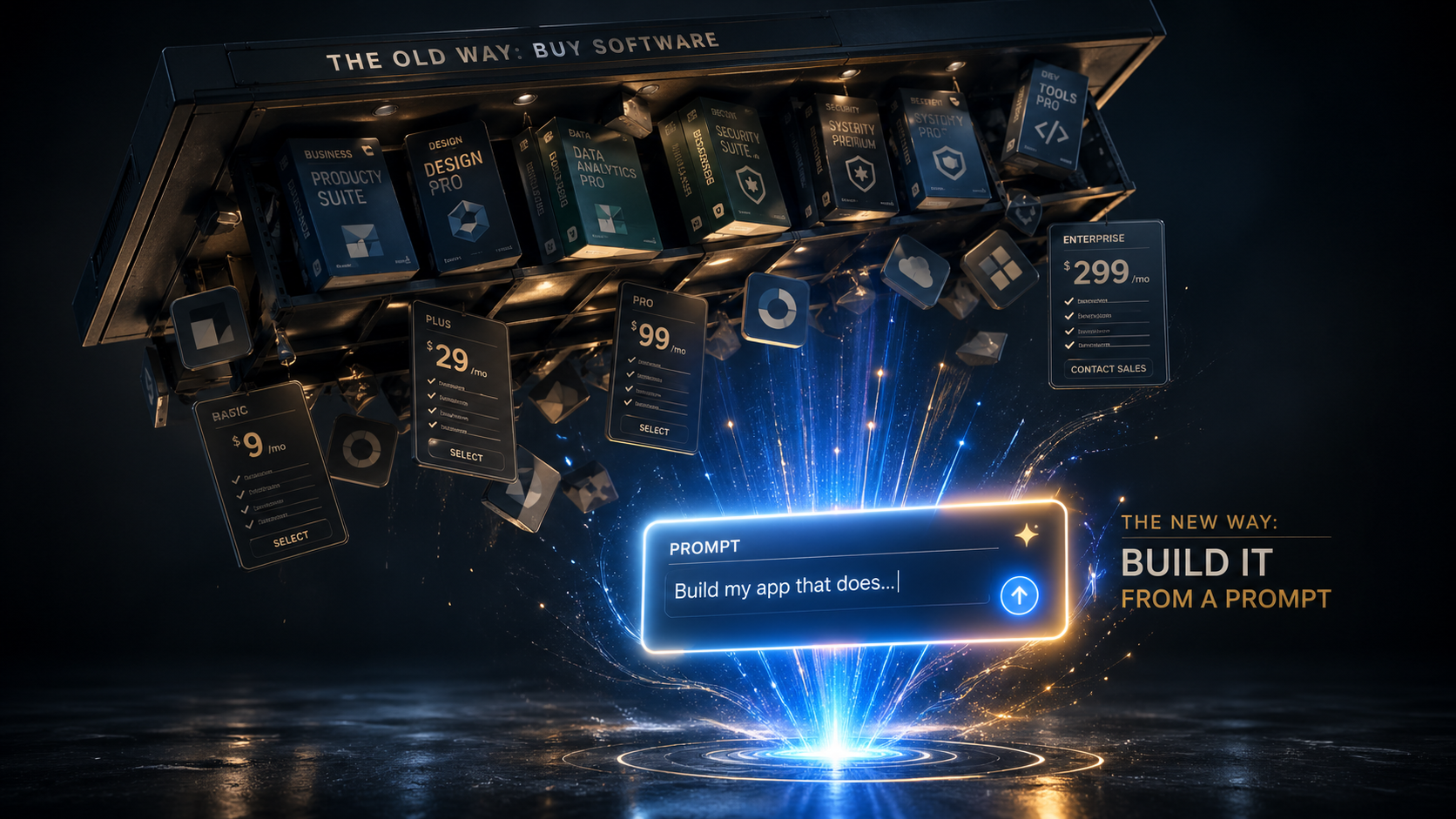
For the last 30 years, the hard part of building a business was building the thing. Software was expensive. You needed engineers. You needed months. A basic SaaS app cost $200K and six months before a single user touched it. Distribution mattered, sure, but the bottleneck was execution.
That bottleneck is gone.
With AI-powered development tools — including CEO.ai's own agent and app builders — a competent operator can ship a functional product in hours. Not a mockup. A working product with a backend, a UI, and real logic. The cost to execute in time and money is compressing toward zero.
So what's hard now? Getting anyone to care. When everyone can build, the product itself stops being the differentiator. Distribution is. The channel you use to reach buyers, the message that resonates with your ICP, the mechanics of how you acquire and grow customers — that's where all the leverage is.
Building a great product that nobody finds is trivially easy now. It's never been more common. And it's a complete waste.
What Is Marketing Driven Development
MDD borrows the core logic of Test Driven Development and applies it to go-to-market. In TDD, the flow is:
-
1Write the test — Define what "passing" looks like before you write code.
-
2Write the code — Build just enough to make the test pass.
-
3Refactor — Clean it up, optimize, repeat.
MDD mirrors that structure, but the "tests" are marketing tests:
-
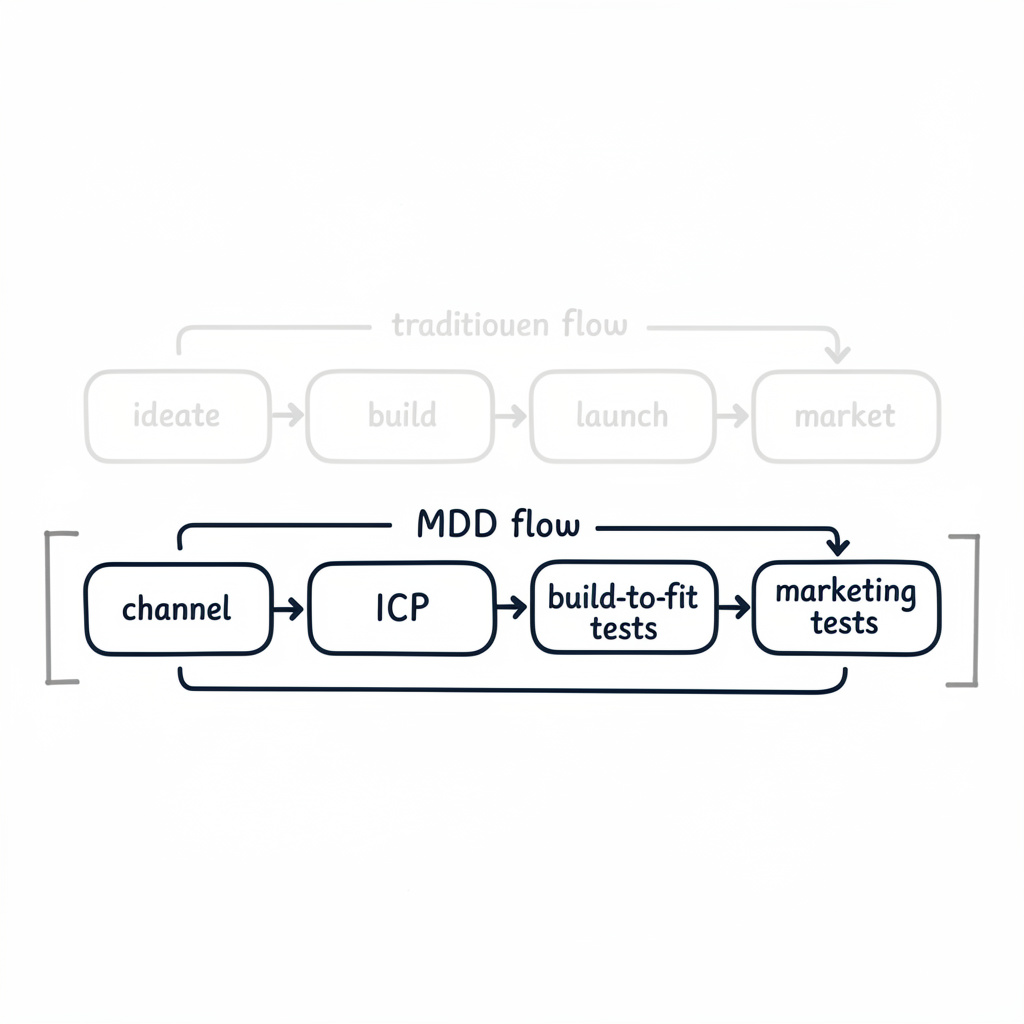
1Define the distribution channel and ICP — Before any building. Where does this product live? Who exactly is it for? What's the acquisition mechanic?
-
2Build the product to fit the channel — Shape every feature, UI decision, and pricing model around what the channel demands.
-
3Run marketing tests immediately — The moment something is shippable, push it into the channel and measure. Did it pass the distribution test?
In MDD, a product that's technically brilliant but doesn't fit its distribution channel is a failing test. You don't ship it. You refactor the product until it passes — or you pick a different channel.
This is a mental model shift. Most founders think: "What should we build?" and then later ask "How do we market it?" MDD reverses the sequence. You start with the channel. The product is shaped by the channel's constraints, not the other way around.
Think about it concretely. A product designed for LinkedIn organic distribution looks fundamentally different from a product designed for cold email. The LinkedIn product needs a "show your work" angle — visible outputs, shareable results, something that generates content naturally. The cold email product needs a dead-simple value prop you can state in 9 words and a quick-time-to-value demo. Same problem space, different products entirely.
The 4-Step MDD Process
Here's how to actually practice Marketing Driven Development. This is the process I'm using now and advocating to every founder I talk to.
Step 1: Pick Your Channel Before Your Feature Set
Start with the distribution channel, not the product idea. Ask: Where does my ideal buyer already spend attention? What acquisition mechanic can I own or at least compete in?
Be brutally specific. "Social media" is not a channel. "Short-form video on LinkedIn targeting ops managers at 20-100 person logistics companies" is a channel. The more specific the channel definition, the more useful it becomes as a design constraint.
- Identify 1-2 channels where your ICP is already active and reachable
- Write down the specific mechanic (SEO? Outbound? Community-led? Partner/referral?)
- Validate that the channel economics work — can you reach 1,000 qualified prospects for less than $5 each?
Step 2: Define Your ICP With Distribution Goggles
The typical ICP exercise asks "who has this problem?" MDD asks a different question: "who has this problem AND is reachable through my chosen channel?"
This is a critical distinction. Plenty of people have the problem. But if they're not concentrated in a channel you can work, they might as well not exist. Your ICP in MDD is the intersection of problem-havers and channel-reachable people. Not just one or the other.
Step 3: Build the Product to Fit the Channel
Now — and only now — do you build. But the channel should be whispering in your ear during every product decision.
If your channel is SEO, you need a product that generates pages, solves search-intent queries, and has a natural free-to-paid funnel. If your channel is outbound sales, you need a product with an instantly demonstrable ROI and a clear "before and after" for a demo. The channel dictates product shape — packaging, pricing, onboarding flow, even feature priority.
This is where AI-first tools become lethal. Because you can build a version of the product in a day using CEO.ai's App Creator, you can shape and reshape the product to fit the channel without burning six months each time. Build fast. Test against the channel. Rebuild.
Step 4: Run Marketing Tests Before Feature Tests
The product is shippable? Good. Don't polish it. Push it into the channel.
Run real marketing tests — ads, outbound sequences, landing pages, content — within 48 hours of having something functional. You're not testing whether the product works (you know it does, you built it). You're testing whether the distribution angle works. Does the ICP respond? Does the channel convert? Does the message land?
If the marketing tests fail, that's the equivalent of a red test in TDD. You don't add more features. You change the product to fit the channel better, you tweak the message, or you pick a different channel entirely. The marketing tests are your source of truth, not your opinion about how cool the product is.
"The best product I ever built got zero users. The ugliest product I ever built got 2,000 paying customers in three months. The difference wasn't the code. It was the channel."
— A founder I talked to last month who asked not to be named
Why This Replaces the Old Playbook
The traditional product development sequence — ideate → build → launch → market — made sense when building was the expensive, slow part. You invested all that time and money in execution, so you had better build something great and then figure out how to sell it.
That logic has collapsed. When building costs approach zero, the old sequence produces a predictable outcome: beautiful products that nobody discovers. The graveyard of AI-generated apps and websites is already overflowing. Every one of those founders thought "build it and they will come."
Three forces are making MDD inevitable:
- Build costs → zero. AI tools make it possible to create functional products in hours. The build phase is no longer the bottleneck or the competitive advantage.
- Supply explosion. Everyone can build now. The market is drowning in products. Attention is the scarce resource, not engineering talent.
- Channel lock-in is the new moat. Owning a distribution channel — a community, an SEO position, a sales motion — is harder to replicate than any feature set. Features get copied in days. Channels take years.
The moat has moved. It used to be "can you build this?" Now it's "can you get this in front of the right 1,000 people and make them care?" Distribution is the new technical advantage.
This doesn't mean product quality is irrelevant. It means product quality is table stakes. You still need something that works, that solves a real problem, that doesn't embarrass you. But the bar for "good enough to test" has dropped so low that spending months perfecting a product before validating its distribution is indefensible.
The founders I see winning right now are the ones who can answer "how will 1,000 people find this?" before they can answer "what features should version 1 include?" They treat distribution as the design constraint, not the afterthought.
Key Takeaways
- Build costs are approaching zero. AI tools have removed the execution bottleneck. The differentiator has shifted to distribution.
- Marketing Driven Development means: channel first, product second. Define where and how you'll acquire customers before you decide what to build.
- Shape the product to fit the channel. Your distribution mechanic should dictate packaging, pricing, onboarding, and feature priority.
- Run marketing tests within 48 hours of having something shippable. The channel's response is your source of truth. Red test = change the product or the channel, not add more features.
- Distribution is the new moat. Channels take years to build. Features get copied in days. Invest accordingly.

Greg Marlin
Founder, CEO.ai
Greg is the founder of CEO.ai, where he's building the platform that lets operators create AI agent teams, apps, websites, and automated workflows using plain English. He writes about the intersection of AI, distribution, and building businesses that scale.