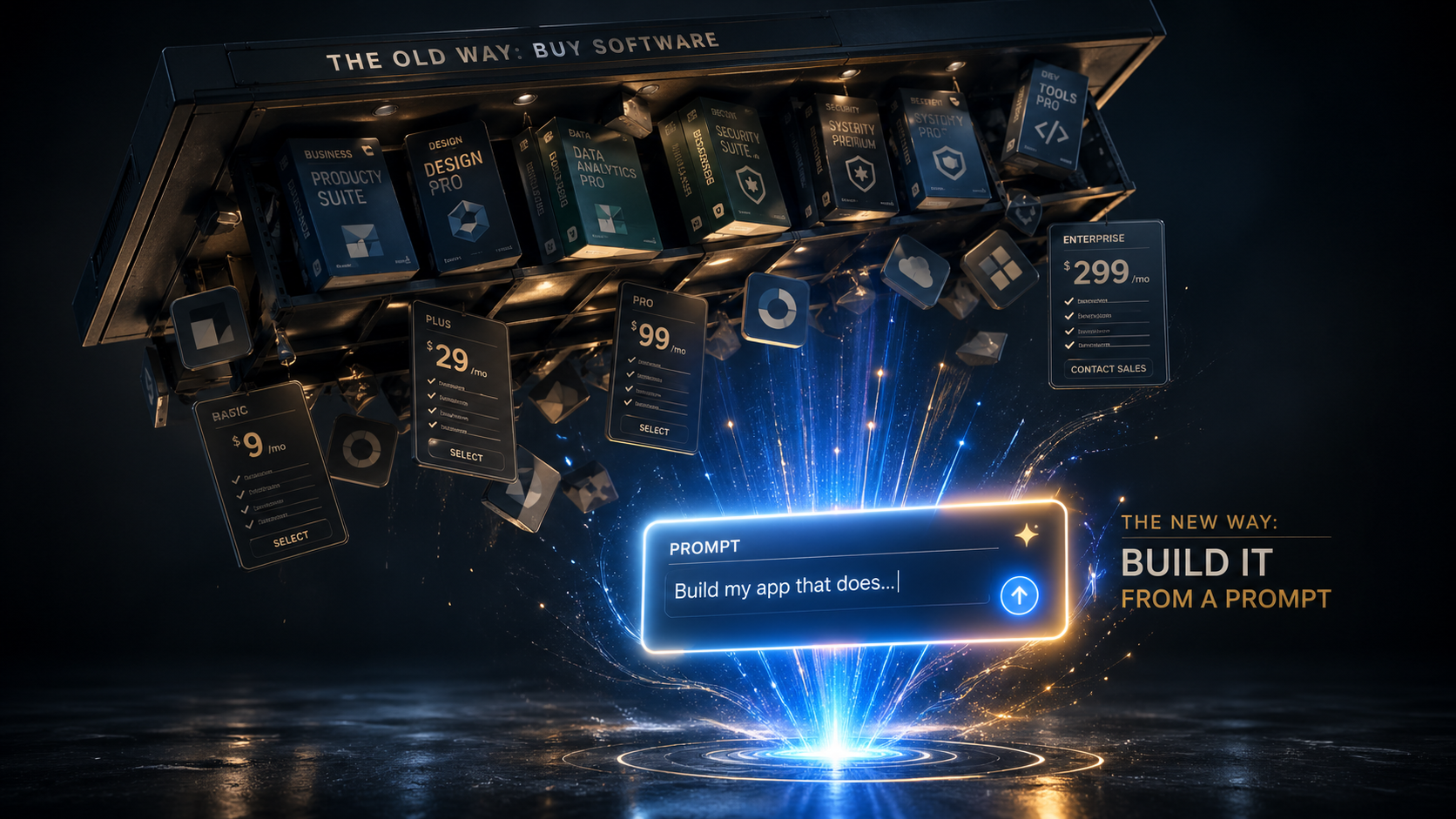
You've been using ChatGPT for months. You've written emails with it, brainstormed campaign ideas, maybe even drafted a few SOPs. You know there's something bigger on the other side — you've heard the terms. AI agents. Custom GPTs. Autonomous workflows. So you tried to level up.
And you hit a wall. Prompt engineering courses that feel like learning a second language. Agent frameworks that require a developer. API keys, system prompts, tool configurations, guardrail logic. You wanted AI to run parts of your business, not a part-time degree in machine learning.
Here's what nobody tells you: the answer isn't learning to build agents. It's having them built for you — an entire roster of them, tailored to your specific business, ready on day one.
The Agent Gap Is Real
First, a quick primer. AI agents are not chatbots. A chatbot answers your question and forgets you exist. An agent has memory. It uses tools. It takes action autonomously. Multiple agents can coordinate with each other — passing context, splitting tasks, working toward a shared goal without you babysitting every step.
This is why every major AI company — OpenAI, Google, Anthropic, Microsoft — is pouring resources into agent infrastructure. The industry consensus is clear: agents are the next paradigm. Chat was the demo. Agents are the product.
But building an effective agent? That's an acquired skill. You need to understand system prompt architecture, tool-use patterns, memory management, output guardrails, and multi-agent coordination logic. Most of this isn't even well-documented yet. It lives in the heads of a few thousand AI engineers worldwide.
The agent gap is the defining bottleneck of 2026. AI's potential has exploded, but the ability to actually harness that potential is still locked behind a steep technical learning curve. Most business owners are stuck on the wrong side of the gap.
Think of it this way: you know Formula 1 cars exist. You've seen what they can do. But right now, all you've got access to is an automatic sedan. The performance gap between chat and agents is that dramatic — and the skill gap to cross it is just as wide.
Why One Agent Isn't Enough
Let's say you power through and build a single good agent. Maybe a content writer that actually sounds like your brand. Congratulations — you've solved roughly 4% of the problem.
A business doesn't run on one function. You wouldn't hire a single employee and ask them to handle marketing, finance, operations, customer success, competitive research, and product strategy. That's insane. Yet that's exactly what people attempt with AI — one ChatGPT window, doing everything, doing nothing well.
Different functions require different specializations. Your marketing agent needs a totally different personality, knowledge base, and toolset than your financial analysis agent. And the real power unlocks when those agents coordinate — when your competitive intelligence agent feeds insights to your brand strategist, who updates the content engine, which generates campaigns your operations manager schedules and tracks.
You don't need an agent. You need a roster.
What an AI Agent Roster Looks Like
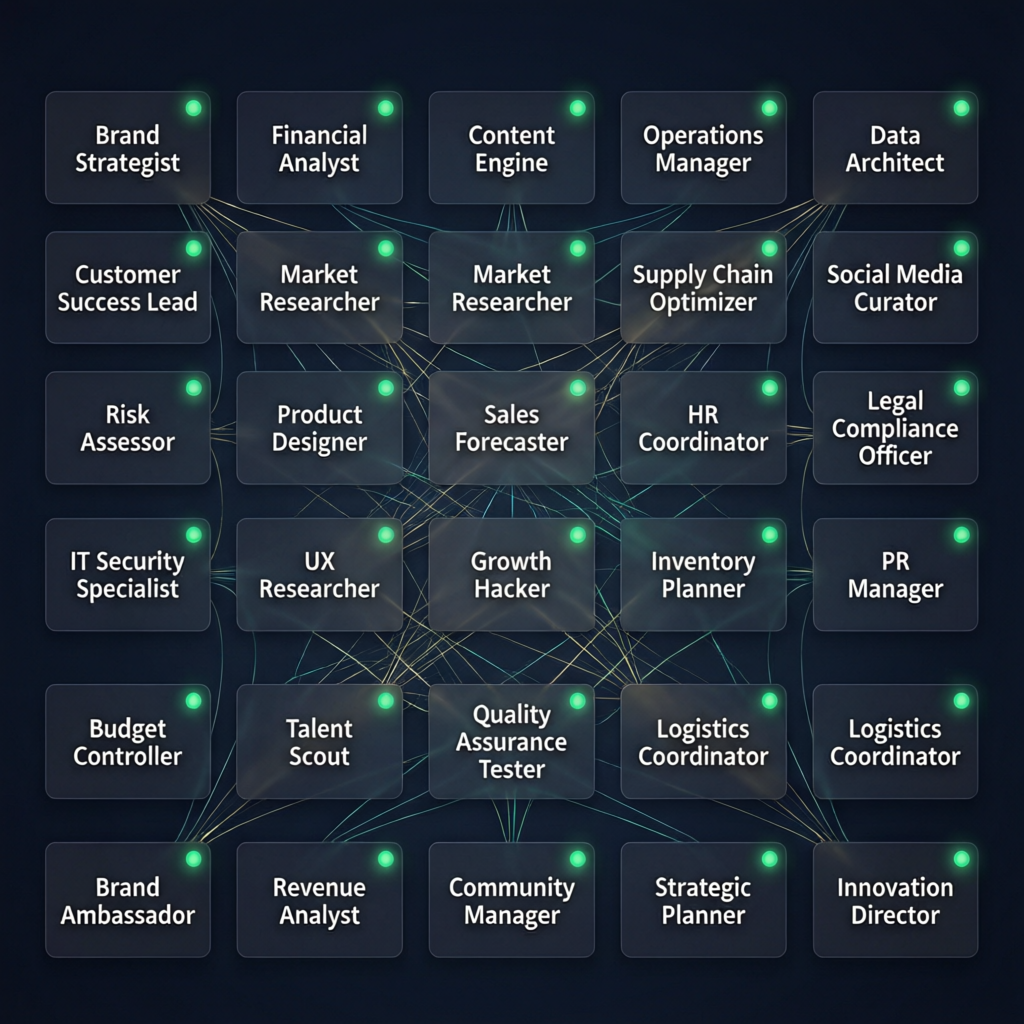
Here's how it works on CEO.ai. You describe your business in a few sentences — industry, business model, what you sell, who you serve, what you're trying to accomplish. That's it. From that single input, the platform generates 25-30 specialized AI agents, each configured for a distinct role in your business.
These aren't abstract. They're concrete and immediately useful:
Brand Strategist
Maintains your voice and positioning across every piece of content. Knows your tone, your differentiators, your audience's language.
Financial Analyst
Tracks your metrics, models scenarios, and flags anomalies before you'd notice them in a spreadsheet.
Content Engine
Produces platform-native content — LinkedIn posts, email sequences, blog drafts, social captions — all in your voice, all on-strategy.
Operations Manager
Coordinates workflows, tracks project milestones, keeps deliverables on schedule without you chasing updates.
Customer Success Agent
Monitors satisfaction signals, drafts follow-up sequences, and surfaces churn risks while there's still time to act.
Competitive Intelligence
Tracks your market, monitors competitor moves, and surfaces insights that would take a human analyst hours to compile.
And that's six of twenty-five to thirty. The full roster spans every function: HR, legal review, product roadmapping, sales enablement, partnership strategy, data analysis, and more.
Critically, these aren't generic templates. Every agent is configured based on your industry, your business model, your goals, and the context you provided. A roster for a SaaS startup looks nothing like a roster for an e-commerce brand or a consulting firm. Because it shouldn't.
The Magic Is in the Memory
When you first get your roster, the agents are smart but general. They know best practices for their role and your industry. Think of them like talented new hires on day one — competent, eager, but not yet fluent in your specific way of doing things.
That changes fast. As you work with each agent through conversation, they build memory: your brand voice. Your pricing strategy and the reasoning behind it. Your customer segments and what resonates with each. Your workflow preferences. Past decisions you've made and what happened next. The agent that writes your content starts sounding exactly like you by week two.
CEO.ai makes this progression visible. You can review each agent's growing knowledge base, see what they've learned, and course-correct if something's off. It's like having an onboarding dashboard for your entire AI team — except these employees never forget a detail, never quit, and get better exponentially faster than any human hire ever could.
They go from good to eerily good. That's the trajectory.
The Old Way vs. The Roster Way
| DIY Agent Building | CEO.ai Roster | |
|---|---|---|
| Time to start | Weeks to months of learning | Minutes of conversation |
| Scope | 1-2 janky agents (if you're lucky) | 25-30 coordinated specialists |
| Quality | Trial-and-error configurations | Best-practice templates, battle-tested |
| Improvement | Manual tweaking, constant maintenance | Automatic, memory-driven, compounding |
The gap isn't subtle. One path asks you to become an AI engineer on nights and weekends. The other asks you to describe your business and start working.
Key Takeaways
AI agents are exponentially more powerful than basic chat — they have memory, use tools, work autonomously, and coordinate with each other.
Building agents is an acquired skill that requires understanding of system prompts, tool usage, memory architecture, and coordination patterns. Most people can't access this.
One agent isn't enough — a business needs a full team of specialists that share context and coordinate work, just like a human team.
CEO.ai generates 25-30 tailored agents from a simple business description, configured for your industry, model, and goals. Zero prompt engineering required.
Agents get smarter through conversation — they build memory of your voice, preferences, and decisions, and you can watch the progress in real time.
You don't need to become an AI expert. You need to focus on your vision, your strategy, your business. Let the roster handle execution. The age of one person with a full AI team isn't coming. It's already here.

Greg Marlin
Founder, CEO.ai
Greg is building CEO.ai to put the power of an entire AI workforce into the hands of every entrepreneur and operator. Before CEO.ai, he spent over a decade building and scaling technology companies. He writes about AI strategy, agent architecture, and the future of work.